Data study
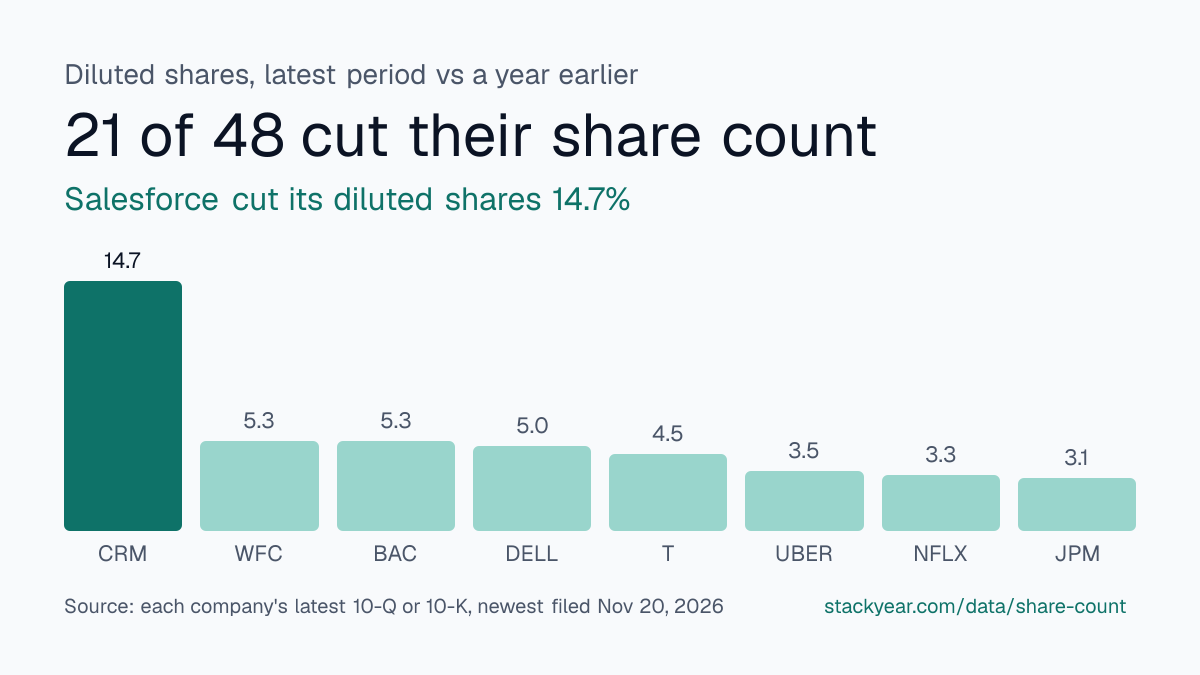
Who shrank their share count in 2026
21 of 48 covered companies had fewer diluted shares in their latest reported period than a year earlier. Salesforce cut its count the most (−14.7%), and Intel added the most (+17.1%).
By Erik Jia · Published Nov 17, 2026 · Figures from each company's latest 10-Q or 10-K, newest filed Nov 20, 2026. The author holds no individual stocks.
A company's share count is the plainest record of whether it is buying back more stock than it hands out. When the count falls, each remaining share is a larger slice of the business; when it rises, existing holders own a smaller one. This study compares each covered company's diluted shares in its latest reported period with the same period a year earlier, beside what it spent on buybacks and what it recorded as stock-based pay over the last 12 months.
What the filings show
- Together the 48 companies spent $383.7B buying back their own stock over the last 12 months.
- The largest buyer, Apple, spent $86.4B; its diluted share count fell 1.9%.
- 8 companies recorded more stock-based compensation than they spent on buybacks, among them Alphabet ($30.4B of stock pay, $5.9B of buybacks), Meta ($26.9B of stock pay, no buybacks) and Broadcom ($8.5B of stock pay, $8.4B of buybacks).
- 27 companies added shares over the year, 5 of them by more than 5%.
Share count, buybacks and stock pay by company
— means the filing does not tag that figure for the period. Hover a figure for its XBRL tag; each links to its filing. McDonald's tags its share count without its scale (for example 708.3 for 708.3 million), so the counts are not shown; the change between the two years is unaffected.
How the figures are built
- Diluted shares are the weighted-average diluted share count each company reports for its latest quarter, or for the full year when its latest filing is a 10-K, against the same period a year earlier (XBRL tag WeightedAverageNumberOfDilutedSharesOutstanding). Both come from the latest filing, which restates the earlier period for any stock split.
- Buybacks are cash paid to repurchase common stock, and stock-based pay is the compensation expense the company records, each over the 12 months to its latest filing. A count can fall less than buybacks suggest because shares are also issued for pay, acquisitions and conversions.
- Every figure links to its filing. The study is research from public filings, not investment advice.
Related
- Share dilution calculator What a change in share count does to an owner's stake.
- Insider trading Open-market insider buys and sells over 90 days, from Form 4.
- AI capex tracker Trailing 12-month capex for the five largest spenders.
- Check your stocks These figures and what the latest filings changed, for your own list of up to 10 tickers.